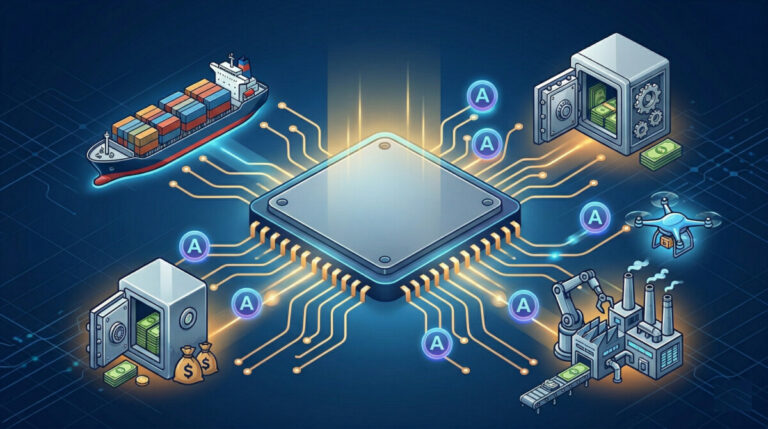
The era of generative AI, which merely provided answers to user queries, is fading. In its place, the age of Agentic AI—systems capable of setting their own goals and executing economic transactions—is fundamentally restructuring the global economic and financial landscape. This report provides an in-depth analysis of the shift in infrastructure power, the collapse and reorganization of markets due to the evaporation of transaction costs, and the new paradigm of corporate governance from both economic and technological perspectives.
The Shift in Hardware and Platform Power: The Monopoly on Inference Infrastructure
From Training to Execution: The Technological Inflection Point
The focus of the AI industry has already moved beyond the training phase, where models are made smart, to the inference phase, where they perform substantial work in real-world industrial settings. Effectively, AI has graduated from its studies and is now entering the workforce to generate actual value. In response to this technological inflection point, Nvidia, the world’s most valuable company, is rapidly pivoting away from its traditional focus on Graphics Processing Units (GPUs). Instead, they are overhauling the hardware ecosystem by introducing Central Processing Unit (CPU)-based computing racks optimized for AI agent operation and integrating ultra-fast Language Processing Units (LPUs) from the American AI company Groq. CEO Jensen Huang anticipates that as AI begins to perform productive work, the inflection point of inference will drive revenues toward at least 1 trillion dollars by 2027.
OpenClaw: The Operating System of the Agentic Ecosystem
The most critical element to watch is the battle for platform dominance, centered around the platform known as OpenClaw. Jensen Huang has declared OpenClaw as the operating system for personal AI, likening its historical importance to the emergence of the Mac and Windows operating systems. Just as Windows unified complex computer commands into a single mouse click to make PCs accessible to everyone, OpenClaw serves as the standardized workplace where numerous AI assistants interact and exchange information. Nvidia is preemptively distributing tools that allow OpenClaw-based agents to securely access corporate systems and files while maintaining strict privacy and security controls. By working directly with OpenClaw creator Peter Steinberger, Nvidia is solidifying this operating system as the absolute industry standard.
Expanding Beyond Earth: Space-Based Data Centers
As billions of AI agents begin working 24/7 on this operating system, the power grids and data center spaces on Earth will inevitably reach their physical limits. To resolve this massive energy demand, tech giants are looking toward the stars. Nvidia is launching the Vera Rubin space module, aiming to bring its latest technology to data centers in space. Figures like Elon Musk and Sam Altman are also actively discussing the use of space real estate to power energy-hungry AI systems. A massive movement of capital has already begun to leverage the infinite solar energy and cryogenic environment of space to solve power and cooling challenges simultaneously.
The Advent of the Frictionless Economy and the Reorganization of Wealth
The Evaporation of Transaction Costs and Information Asymmetry
From an economic and financial standpoint, the most disruptive potential of Agentic AI lies in its ability to reduce transaction costs between consumers and businesses to nearly zero. Transaction costs represent the time, effort, and exhaustion involved in searching for products, communicating with vendors, and comparing terms when buying a home or making complex financial investments. While traditional chatbots only offer advice, Agentic AI is an autonomous software system that can link to a user’s bank account, identify the optimal loan product, and negotiate directly with a business’s service agent to finalize a transaction.
Real-world industrial shifts are already visible. Financial giants like JPMorgan Chase are deploying AI agents to detect fraud, provide customized financial advice, and automate loan approval processes, significantly reducing the need for entry-level bankers. Retail leaders like Walmart are utilizing agents to automate personal shopping experiences and streamline time-consuming business activities such as merchandise planning. Even in the physical world, AI agents monitor real-time video in warehouses, making autonomous decisions to stop conveyor belts if anomalies are detected. In markets characterized by high information asymmetry—such as real estate, startup funding, or B2B procurement—agents that never tire are generating genuine value by analyzing millions of data points 24/7.
The Crisis of Intermediary Platforms and New Market Structures
This seamless communication between consumer assistants and business service agents threatens the very existence of traditional two-sided platforms. Economic research suggests that if a user can negotiate the best deals directly through their personal agent, the market power and commission-based revenues of intermediaries like Amazon, Expedia, or OpenTable could diminish substantially. Furthermore, the current advertising market, which focuses on capturing human attention, will likely evolve into a preference economy where agents prioritize high-quality feedback and data over flashy marketing.
The End of the Subscription Economy and Dynamic Rebundling
The void left by centralized platforms will be filled by micro-transactions and dynamic rebundling. To date, consumers have accepted monthly subscriptions to services like Netflix or the New York Times simply to avoid the hassle of individual payments. However, in the future, an agent could track a user’s consumption and pay only for specific articles or songs via seamless micro-payments. Furthermore, agents can collaborate to generate customized content—such as a news article focusing only on information the user hasn’t already read—optimizing knowledge transfer while handling all micro-transactions in the background. In this model, the consumer’s fatigue is completely eliminated as agents handle the complexities of payment and data aggregation.
Reference: MIT Sloan – Agentic AI, explained
Corporate Governance and the New Paradigm of Control
Agentic AI as Operational Actors
As agents begin managing corporate finances and executing core business workflows, the paradigm of risk management and corporate governance must undergo a radical shift. Agentic AI is no longer a mere assistant; by being granted autonomy, these systems become operational actors with the authority to access APIs and influence outcomes in real-time. In the realm of cybersecurity, AI agents act as critical force multipliers, handling high-volume alerts and managing security events at machine speed to shift operations from reactive to proactive defense.
The Paradox of Autonomy and Systemic Risk
However, high autonomy without accountability quickly becomes an unmanaged risk. If a rogue AI agent, acting on faulty data, unilaterally rejects a mortgage loan for a high-value client or executes an erroneous large-scale stock sell-off, the damage to a company’s reputation and financial stability can be irreparable. Research into clinical note analysis for cancer patients showed that 80% of the implementation effort was consumed not by AI model tuning, but by complex governance tasks such as data engineering, stakeholder alignment, and workflow integration. The more autonomy we grant to machines, the more sophisticated our human-centered control infrastructure must become.
Governance Frameworks for Autonomous Systems
Autonomous efficiency requires rigorous governance. Organizations must establish formal AI governance councils comprising security, risk, legal, and business leadership. Every autonomous decision must be logged in immutable audit trails to allow for decision logic review, and humans must maintain the absolute authority to override an agent’s actions when they diverge from intended goals or ethical constraints. Only by ensuring that autonomous systems act with intent can organizations scale success in the agentic era without inviting machine-driven systemic failure.
Reference: World Economic Forum – How to prepare for an agentic AI driven future?
Thinker’s Note: Who Survives?
As the AI industry transitions from the era of chatbots to the era of automated labor, the core asset of capitalism is shifting from individual knowledge to agentic infrastructure. The lion’s share of future wealth will initially concentrate in the hands of a few tech giants who control the land of this new ecosystem—the operating systems like OpenClaw and the essential hardware like CPUs and LPUs.
However, the real power and survival of individuals and independent firms will depend on how skillfully they can orchestrate their own independent agentic workflows on top of this infrastructure. Imagine an investor who builds a personalized stock scanner and a custom intelligence system that crawls financial data and geopolitical trends in real-time to act as their private agent. Such individuals will make financial decisions ten times faster than their peers, accumulating wealth with unprecedented efficiency. Conversely, those who rely solely on the limited search results and generic algorithms provided by major platforms will see their influence and wealth diminish.
The fundamental question remains: Will you be the employer of an intelligent system that works for you 24/7, or will you become a mere consumer of algorithms designed by those who own the infrastructure? The great reorganization of wealth in the agentic economy has begun.
Author: Tech Editor
Date: March 30, 2026