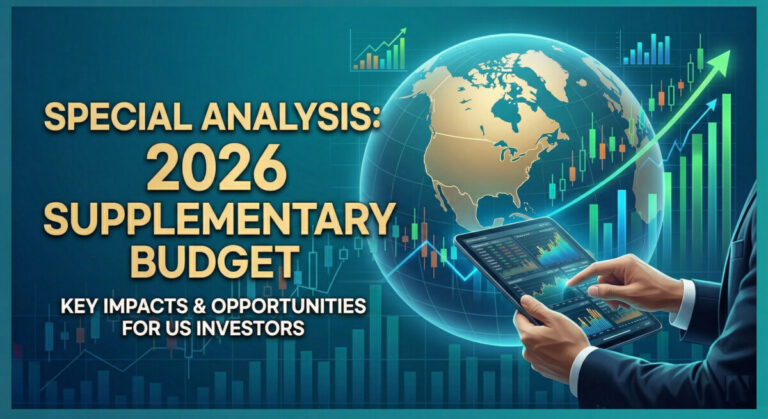
(2026 Supplementary Budget Special: Part 3)
The AI Transformation and Next-Generation Supply Chain Leadership Fueled by 2.6 Trillion Won
Executive Summary: This report analyzes how the 2.6 trillion won supplementary budget earmarked for industrial and supply chain stability will transcend mere corporate bailouts to catalyze a profound structural realignment centered on manufacturing-sector AI Transformation (AX) and energy sovereignty.
1. Strategic Deployment: Moving Beyond Defensive Lines toward Future-Proofing
While macroeconomic indicators and household subsidies served as a temporary ventilator for the “frontline of consumption,” the 2.6 trillion won discussed here acts as a long-term vaccine and tonic for the heart of the South Korean economy: its industrial and export ecosystems. In response to global supply chain disruptions and the crises triggered by Middle East instability, the government has strategically allocated 2.6 trillion won of the total 26.2 trillion won supplementary budget to “Industrial Impact Minimization and Supply Chain Stability.”
A closer look at the budget allocation reveals the administration’s strategic intent. Approximately 1.1 trillion won is deployed as an immediate fire suppressant for export enterprises and industries on the brink due to disrupted logistics. Another 0.7 trillion won forms a defensive shield for the stable supply of strategic resources and naphtha—the lifeblood of the petrochemical sector. The most significant focus, however, is the remaining 0.8 trillion won. Rather than mere recovery, this capital is an investment in securing dominance in future industries through the transition to new energy sectors and the Artificial Intelligence Transformation (AX) of industrial manufacturing processes.
2. Hypothesis & Verification: Can Industrial Subsidies Drive Substantive Structural Improvement?
[Hypothesis 1] Massive policy financing and subsidies will merely extend the lifespan of marginal firms.
In this proposal, the government provides 650 billion won in fiscal support as “seed money” to channel a total of 7.1 trillion won in export policy financing through the financial sector. Furthermore, it is directly injecting 500 billion won to cover 50% of the cost increases for naphtha imports, an essential raw material for manufacturing daily necessities like plastics. From a traditional economic perspective, critics argue that such large-scale financial support and price subsidies risk becoming a survival mechanism for uncompetitive firms, ultimately leading to an inefficient allocation of national resources.
Critical Perspective and Policy Compromise: While theoretically sound, this critique overlooks practical complexities. The collapse of the naphtha supply chain or the bankruptcy of profitable export firms would mean the paralysis of the nation’s entire industrial value chain. To mitigate moral hazard risks, the government is not merely providing capital; it is strengthening a “conditional compromise” by linking support to structural upgrades. This includes 7 billion won for technical consulting and retraining for the petrochemical and steel sectors to transition into high-value-added structures.
[Hypothesis 2] Manufacturing AI (AX) and Renewable Energy investment will fundamentally resolve the energy crisis.
The government is accelerating the nationwide AI transformation by investing 14 billion won in data center verification and 75 billion won in pioneering “Smart Factory AX.” Additionally, it has increased support for renewable energy facilities, such as solar and wind power, to 1.1 trillion won. The positive hypothesis is that by reducing fossil fuel dependency and maximizing production efficiency through AI, the economy will develop fundamental immunity against future external energy shocks.
Risk Check (The Lag Effect): While the long-term direction is correct, the “Time Lag” remains a clear constraint. Establishing AI verification centers and installing power generation facilities requires significant time. For companies currently suffering from skyrocketing logistics costs, AI and renewable energy are future solutions rather than immediate stopgaps. Therefore, this investment should be viewed as an essential cost for long-term survival rather than an immediate fix for current inflation, necessitating continued supplementary measures in the interim.
3. Deep Analysis: Two Major Mega-Trends Emerging from the Crisis
Shrewd market participants should identify where the government is placing its “stepping stones” for the future within this 2.6 trillion won budget. The sectors poised for the most explosive growth amid this crisis are as follows:
- ① Datafication of ‘Tacit Knowledge’ and the Scaling of Manufacturing AX: The most innovative aspect of this budget is the allocation of 80 billion won to datafy the “tacit knowledge” of master artisans in key industries like shipbuilding, steel, and automobiles. This involves extracting the intuitive skills of veteran workers and embedding them into AI systems—a state-led initiative that marks a transition from simple automation to a truly self-optimizing “Smart Factory” ecosystem.
- ② Supply Chain Sovereignty and Next-Generation Smart Grids: While securing 1.3 million barrels of oil reserves and expanding rare earth recycling facilities represent the basics of resource security, the 58.8 billion won investment in “AI-integrated Decentralized Power Grids” (increasing the target to 30 sites) deserves closer attention. As power-hungry data centers and smart factories proliferate, conventional grids will be insufficient. Establishing smart grid infrastructure where AI optimizes energy distribution based on real-time demand is becoming an essential prerequisite for national survival.
4. Thinker’s Insight: Transforming Vulnerability into Strategic Leadership
In conclusion, the 2.6 trillion won industrial and supply chain supplementary budget represents a sophisticated “Two-Track” strategy. On one hand, through naphtha subsidies and 7.1 trillion won in policy financing, the government is “buying time” for corporations to survive the current geopolitical storm. Simultaneously, it is utilizing that time to execute a structural realignment of the industrial sector toward an AI and renewable energy-centric model.
While massive fiscal injections inevitably bring costs—such as inflationary pressure and market distortions—stopping investment now would be equivalent to surrendering future industrial leadership. Rather than being paralyzed by the 1,540 KRW/USD exchange rate, investors must identify the AI infrastructure and next-gen power grid solution providers that will innovate manufacturing. Now is the imperative moment to align assets with these emerging mega-trends.
[References and Sources]
- Ministry of Planning and Budget, “2026 Supplementary Budget Proposal: Detailed Industrial and Supply Chain Stability Plans.”
- Ministry of Planning and Budget, “Major Support Programs by Beneficiary and Energy Industry Transition Roadmap.”
- Ministry of Planning and Budget, “Promotional Materials and Infographics on Industrial Process AX Leadership Initiatives.”
Author: Economic & Finance Team Editor
Date: March 31, 2026